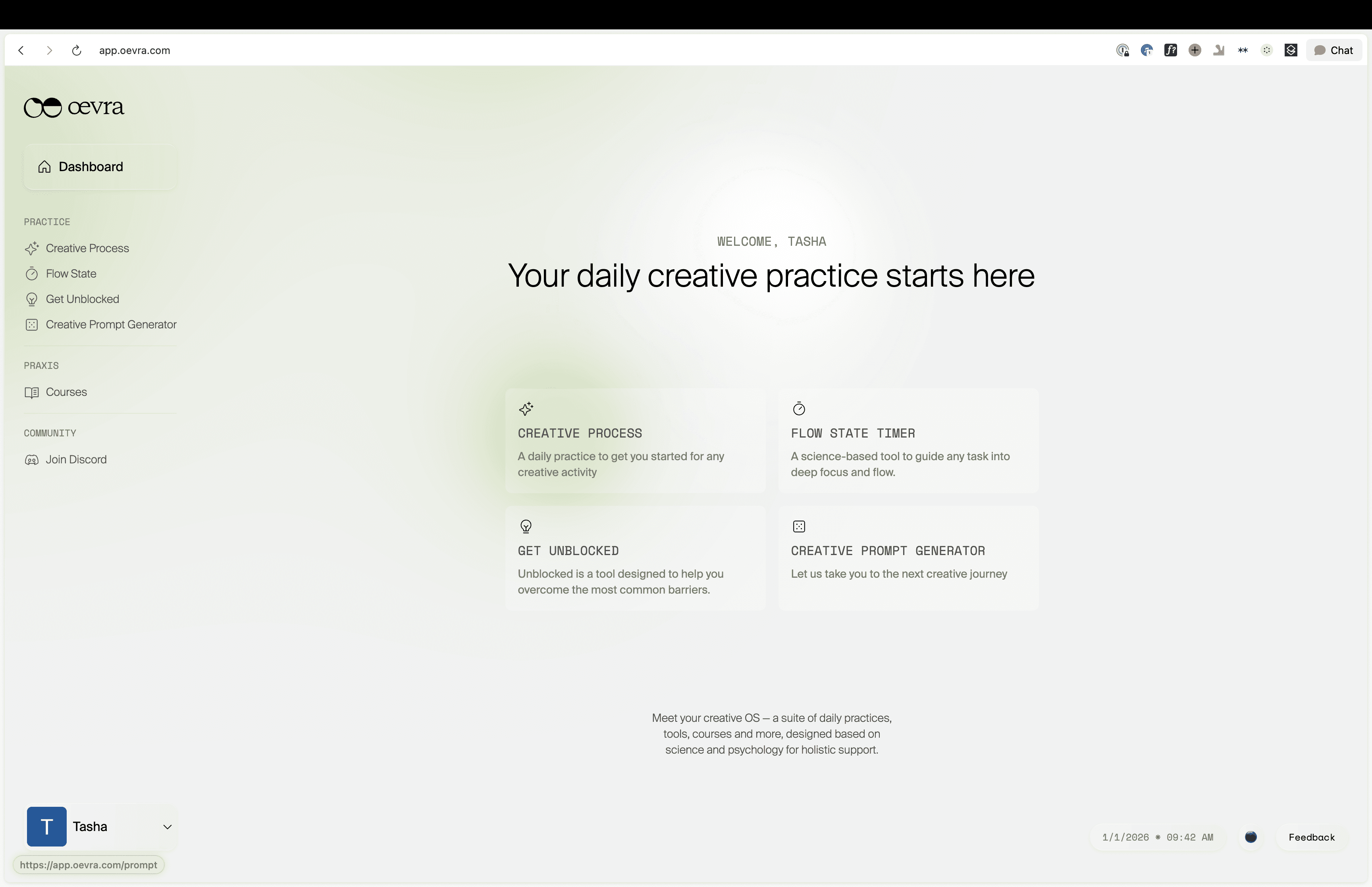
oevra


the creative process app
Year
'25
Year
'25
Year
'25
oevra is the first app designed to enhance your creativity and help you get into the flow state, based on neuroscience and psychology.
© oevra
© oevra
© oevra


Creative thinking is among the most sought-after skills for the future.
The World Economic Forum's 2025 Future of Jobs Report states that creativity as a skill will be increasingly important to adapt to our rapidly changing world. Paradoxically, as AI reshapes the way we live and work, we’re facing what experts call a “long-term creativity decline” due to growing dependence on these tools.
Human existence is increasingly mediated by digital interfaces, without the nervous system capacity to cope.
Algorithms now shape how we think, feel, consume, and relate to ourselves and the world around us. In conceptualizing and creating oevra, we asked: How can we use AI to promote creativity instead of replacing or outsourcing it? How can we navigate digital landscapes with agency, intuition, and sensitivity? Our design thinking must optimise for wellbeing and serve diverse individual needs. In developing oevra, we delved into research papers in neuroscience and psychology, as well as work by psychologists, philosophers, and theorists.
Creative thinking is among the most sought-after skills for the future.
The World Economic Forum's 2025 Future of Jobs Report states that creativity as a skill will be increasingly important to adapt to our rapidly changing world. Paradoxically, as AI reshapes the way we live and work, we’re facing what experts call a “long-term creativity decline” due to growing dependence on these tools.
Human existence is increasingly mediated by digital interfaces, without the nervous system capacity to cope.
Algorithms now shape how we think, feel, consume, and relate to ourselves and the world around us. In conceptualizing and creating oevra, we asked: How can we use AI to promote creativity instead of replacing or outsourcing it? How can we navigate digital landscapes with agency, intuition, and sensitivity? Our design thinking must optimise for wellbeing and serve diverse individual needs. In developing oevra, we delved into research papers in neuroscience and psychology, as well as work by psychologists, philosophers, and theorists.
Creative thinking is among the most sought-after skills for the future.
The World Economic Forum's 2025 Future of Jobs Report states that creativity as a skill will be increasingly important to adapt to our rapidly changing world. Paradoxically, as AI reshapes the way we live and work, we’re facing what experts call a “long-term creativity decline” due to growing dependence on these tools.
Human existence is increasingly mediated by digital interfaces, without the nervous system capacity to cope.
Algorithms now shape how we think, feel, consume, and relate to ourselves and the world around us. In conceptualizing and creating oevra, we asked: How can we use AI to promote creativity instead of replacing or outsourcing it? How can we navigate digital landscapes with agency, intuition, and sensitivity? Our design thinking must optimise for wellbeing and serve diverse individual needs. In developing oevra, we delved into research papers in neuroscience and psychology, as well as work by psychologists, philosophers, and theorists.