ambient systems

research, theory
Ambience vs. algorithms — reimagining the platform to prevent the homogeneity of human thought and desire
With recent studies showing an emerging crisis of an "Artificial Hivemind," long-term creativity decline and "homogeneity of thought," there is an urgent need to reevaluate the tools we use and how we use them responsibly.
Written by Tasha Young
All machines replicate a poetic gesture.
Through this lens, we can understand our increasingly algorithmic interface with the world.
Gilbert Simondon understood machines as stabilized human operations externalized beyond the body; Deleuze & Guattari understood desire itself as machinic — productive, connective, and already embedded in systems.
Take algorithmic systems, for example. The algorithm is an expressive machine that operates on three desire-related layers at once:
anticipation
pattern recognition
desire projected forward in time
Deleuze and Guattari insist that desire is production rather than representation: “desire produces reality.” Algorithmic systems — recommendation engines, optimization pipelines, LLM stacks — are technical “social machines” whose inputs/outputs couple with bodies, affects, and institutions. They are not themselves “desire” in a psychological sense, but they can function as parts of machinic assemblages through which desiring production flows: segmenting attention, modulating intensities, decoding and recoding signals, and feeding back into subject formation.
How do algorithmic systems replicate poetic gestures?
A poem:
isolates a human intensity
fixes its rhythm
repeats it across readers
without needing the original body present
The algorithm does the same — but at scale. It systematizes:
attraction
curiosity
aesthetic pull
social mirroring
The result is a desire-machine replicating poetic gestures into something grotesquely optimized and stripped of humanity. The algorithm is a desiring-machine plugged directly into other desiring-machines.
What does this do to desire, attention, time?
1. Gesture capture (pre-conscious)
hesitations
scroll velocity
rewatching
micro-pauses
reaction-gestures
These bodily and affective gestures are typically surreptitious when performed in a human context, now ruthlessly surveilled in our palms.
2. Pattern abstraction (non-representational)
flow → interruption → re-routing → intensification
repetition with variation
desire treated as actionable, but insatiable
In effect, the algorithm composes with you.
3. Amplification through controlled smoothness
The system:
removes friction
equalizes surfaces
smooths transitions
enforces continuity
Therefore, desire never resolves; it circulates. This is why the experience feels addictive and almost anesthetizing, yet never satisfying — a kind of modulated intimacy.
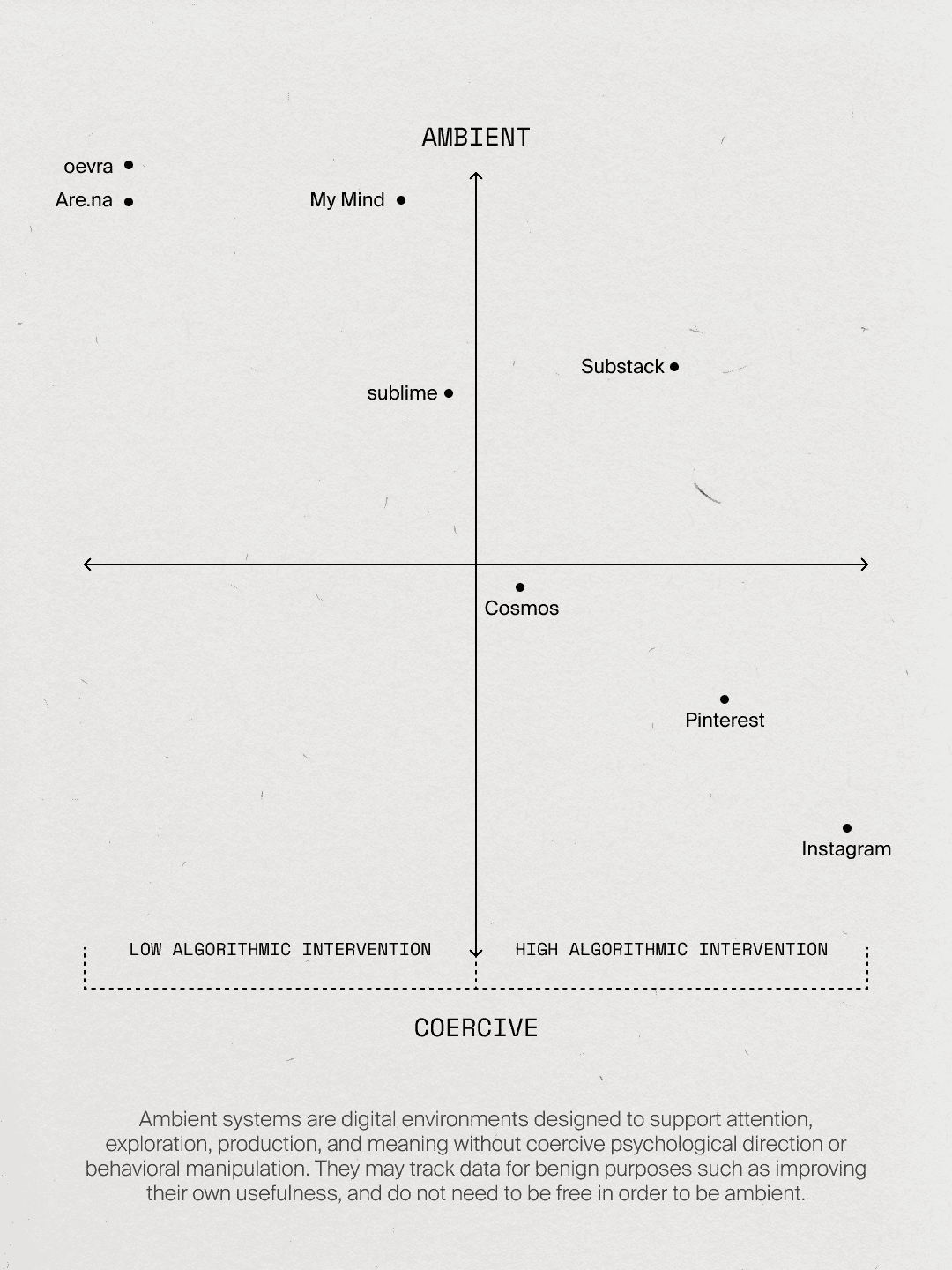
Ambient systems are a possible approach to reclaim autonomy.
Ambient systems are technologies (in particular, how we use the internet for connection and work) designed to function as a kind of 'absolute background' (D&G).
Instead of capturing attention or enclosing desire, ambient systems support agency and creative emergence by respecting the needs and conditions of the human user, rather than seeking to exploit them. Where algorithmic systems optimize behavior, ambient systems optimize the conditions under which behavior can remain freely chosen.
Tender Digitality, edited by Charlotte Axelsson, explores how we need human tenderness to navigate the overwhelming, multi-dimensional, out-of-body experience we have in digital spaces. Mindful design can re‑embody the experience. Tenderness is framed as a deeply serious and aesthetic moment, a way of noticing the barely tangible. Applied to digital life, it means designing and interacting with tech that slows us down enough to feel: touch, hold, linger, recall, re‑order, reflect.
Our digital experiences may feel “bodyless,” where movement is multidimensional and constantly branching. That mismatch—our nonlinear bodies inside non‑stop, modal interfaces—produces shorter attention spans, confusion, and a dulling of empathy. The remedy isn’t less tech; it’s bringing tenderness into the design and use of digital spaces.
One example of a popular proto-ambient system is are.na:
1. No predictive algorithm: What you see is shaped by intentional human linking.
2. Exploration over extraction: Designed for wandering and autonomous connection-making, not attention-capture.
3. Connection without compulsion: It functions as infrastructure for thought, not spectacle.
Where algorithmic systems optimize behavior, ambient systems optimize the conditions under which behavior can remain freely chosen. Where algorithmic systems act as figures that intervene and decide, ambient systems remain infrastructural — enabling emergence while refusing to dominate it.
œvra was conceptualized to be an ambient system, too — a system created to enhance creativity and the flow state without impositions of productivity, and designed (aesthetically and UI) with tender digitality in mind.